Water Damage Restoration in Rochester, NY
Rochester property owners can face water losses shaped by cold winters, snowmelt, heavy rain and frozen-pipe risk. Building access also matters because multifamily buildings, older housing stock, basements and shared plumbing systems can hide moisture in very different ways.
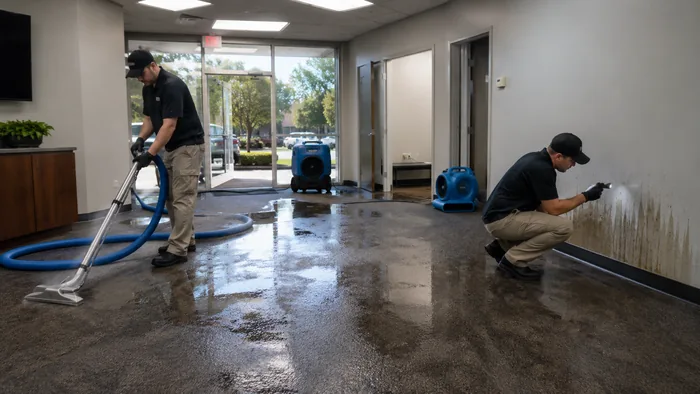
Local restoration context in Rochester
New York conditions can include cold winters, snowmelt, heavy rain and frozen-pipe risk. Property types such as multifamily buildings, older housing stock, basements and shared plumbing systems can affect how easily a contractor can inspect floors, walls, ceilings and concealed cavities.
Common loss categories worth separating include frozen pipes, water between floors, basement intrusion, roof leaks and plumbing failures. Those are planning categories, not fabricated city-level frequency statistics.
Do not confuse extraction with drying
Removing standing water is only the first stage. Structural drying deals with moisture that remains inside materials and assemblies, often after the visible water is gone.
Plan for debris and disposal
Selective demolition produces debris, and contaminated losses may require more controlled handling. The estimate should state who removes damaged materials and whether disposal is included.
Do not let urgency decide the entire project
Immediate mitigation can be necessary, but that does not mean the same company must automatically perform every repair. Homeowners can stabilize first and compare reconstruction options later.
Review quantities line by line
Differences in square footage, linear footage, equipment counts or demolition quantities often explain estimate gaps. Comparing quantities is more useful than arguing about the total alone.
Use measurements, not touch
A surface can feel dry while deeper material remains wet. Moisture readings, reference areas and trend measurements are more reliable than appearance alone when deciding whether equipment can be removed.
Ask what is excluded
A low estimate may omit content handling, demolition, cleaning, reconstruction or source repair. Exclusions often explain more of the price gap than hourly rates or equipment charges.
Map the full moisture boundary
Visible water rarely defines the whole loss. Moisture can move under flooring, behind cabinets, through wall cavities or into the ceiling below. A useful local guide should explain how a contractor verifies the boundary rather than assuming the stain marks the end of the problem.
Plan the transition to reconstruction
Drying can be technically complete while the home is still missing flooring, drywall, cabinets or trim. Ask who owns the handoff and what documentation accompanies it.
Think in layers
Flooring may cover underlayment and subfloor; walls may contain insulation and framing; cabinets can trap moisture behind toe kicks. A local estimate should make clear which layers were actually evaluated.
Ask how cavities will be verified
A wall or cabinet cavity can remain wet even when its surface looks normal. A contractor should explain how inaccessible areas will be checked and what evidence is used to decide that they are dry.
Three loss scenarios to think through in Rochester
Plumbing failures
When a loss begins with plumbing failures, the first task is to confirm the source and map how far moisture moved. The repair decision then depends on contamination, material type, access and elapsed time. The same source can create a minor job in one property and a much larger project in another.
Frozen pipes
When a loss begins with frozen pipes, the first task is to confirm the source and map how far moisture moved. The repair decision then depends on contamination, material type, access and elapsed time. The same source can create a minor job in one property and a much larger project in another.
Roof leaks
When a loss begins with roof leaks, the first task is to confirm the source and map how far moisture moved. The repair decision then depends on contamination, material type, access and elapsed time. The same source can create a minor job in one property and a much larger project in another.
How to compare two Rochester restoration estimates
| Item | What to compare | Why it matters |
|---|---|---|
| Rooms and surfaces | Exact areas included | Different boundaries create different totals. |
| Materials | Dry in place vs remove | Material decisions change mitigation and rebuild scope. |
| Equipment | Type, count and estimated days | Drying plans should be comparable. |
| Cleaning | Standard cleaning vs contaminated-loss procedures | Source and contamination change the work. |
| Reconstruction | Included or excluded | A mitigation-only quote is not a full repair quote. |
| Documentation | Photos, moisture logs and change orders | Written records make scope changes easier to verify. |
What this page deliberately does not invent
There is no reliable reason to publish a made-up “average Rochester price” or a fictional list of local providers just to make a page look more specific. Where no dependable city-level data exists, this guide focuses on the real decision variables that change scope and cost.
Estimate the physical scope before comparing quotes
Use Water Damage Calculator to organize rooms, materials and loss type before you compare contractor proposals.
Calculate Water Damage →Additional questions before you hire
How to evaluate a mitigation authorization
Read what the authorization permits before work starts. Check whether it covers emergency mitigation only or also allows demolition, reconstruction, direct insurance billing or assignment of other rights. The document should match what you actually intend to hire.
How to handle hidden-damage discoveries
Hidden damage does not automatically mean every proposed change is justified. Ask what was discovered, where it was located, how it was documented and why it changes the original scope. Specific evidence is more useful than a generic statement that 'more damage was found.'
What makes documentation useful for insurance
Useful documentation connects a physical condition to a specific repair decision. Photos, measurements, written scopes and receipts are stronger than a bare total because they explain why work was considered necessary.
Frequently asked questions
What does 'mitigation' mean?
It means taking steps to limit additional damage, such as source control, extraction, drying and selective removal.
Can I open windows to help drying?
Sometimes, but not always. If outdoor air is humid, it can slow drying instead of helping.
Can a small leak affect the room below?
Yes. Water can migrate by gravity through floors, ceilings and wall cavities.
Can I hire one company for mitigation and another for reconstruction?
Yes. Those phases can be separated if that better fits the project.
Does the restoration company repair the leak source?
Not necessarily. A plumber, roofer, HVAC technician or another trade may be needed.
Why is monitoring important?
It shows whether moisture levels are actually improving and helps determine when equipment can be removed.
Should I choose the cheapest quote?
Not automatically. First make sure both quotes describe the same work and have similar exclusions.
Does homeowners insurance automatically cover water damage?
No. Coverage depends on the cause of loss, policy language, deductible and exclusions.
Do wet materials always have to be removed?
No. The decision depends on material type, contamination, deformation, access and drying potential.
Why should I ask where the scope ends?
Because one estimate may stop at dry structure while another includes the final repairs.
Can the final scope grow after work starts?
Yes. Hidden wet materials can be discovered after baseboards, flooring or wall finishes are removed.
What records should I keep?
Photos, videos, estimates, invoices, moisture logs, drying records and written change orders are useful records.