Structural Drying Service
Structural drying is the controlled use of dehumidification, air movement, temperature and monitoring to reduce moisture in building materials.
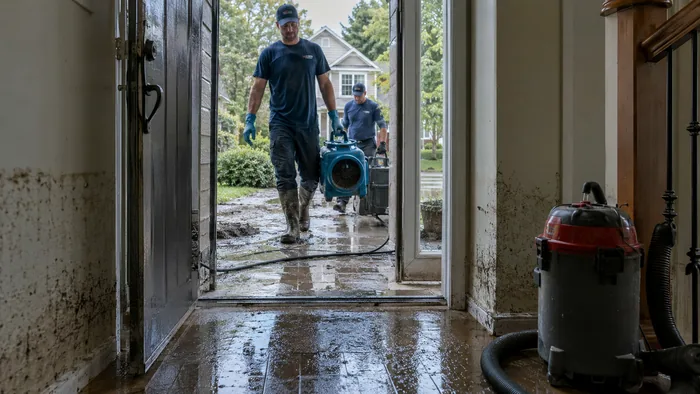
What is included in structural drying service?
The core scope commonly includes moisture targets, dehumidification, air movement, monitoring and selective access. Depending on the loss, the same contractor may also perform demolition, contents handling, cleaning, mold-related work or reconstruction. Those additional stages should be itemized so you know what the quoted price actually buys.
| What to ask | Why it matters |
|---|---|
| How soon can a crew inspect the property? | Response time matters when active water or spreading moisture is present. |
| How will the affected area be documented? | Moisture maps, photos and readings make the scope easier to understand and compare. |
| What materials do you expect to remove? | Removal assumptions directly affect both mitigation and later repair costs. |
| How long will drying equipment run? | Equipment count and duration can be meaningful line items. |
| Does the quote include reconstruction? | A mitigation-only quote should not be compared with a full restoration quote as if they were identical. |
When is structural drying service usually needed?
The strongest buying signal is not simply visible water. It is a situation where a property owner needs the source controlled, water removed or materials dried before additional damage occurs. Contaminated water, large losses, hidden moisture, multi-room spread, electrical concerns and complex building assemblies all make professional assessment more valuable.
What should happen during the first visit?
Safety and source review
The crew identifies immediate hazards and confirms whether the source has stopped or needs another trade.
Moisture assessment
Visible water is only part of the loss. Walls, floors, insulation and cavities may need moisture checks.
Scope decision
The contractor distinguishes materials that may be dried from materials likely to require removal.
Stabilization
Extraction, protection, containment or drying equipment begins according to the actual conditions.
How much should you budget before the inspection?
Use national restoration data as context only. HomeAdvisor's June 2026 data reports many projects in the $1,383–$6,371 range, with a broader span from roughly $450–$16,000. A service-specific quote can be below or above those figures because the final number depends on how much of the full restoration sequence is included.
This is precisely why the main calculator is useful: it makes you specify the variables the national average cannot see.
How do you choose between restoration providers?
- Compare the actual scope and response commitment.
- Ask how moisture and drying progress will be documented.
- Confirm whether contaminated-water procedures are required.
- Verify what demolition is assumed and why.
- Clarify whether the company performs repairs or stops after mitigation.
- Ask for a written explanation of exclusions and possible change-order triggers.
- Check applicable licensing, insurance and local requirements before hiring.
Turn this cost guide into a property-specific estimate
National benchmarks are useful for context, but your affected area, water category, materials and elapsed time determine whether the job resembles a minor mitigation project or a much larger restoration.
Calculate My Structural Drying Service Cost →Related service guides
Sewage Cleanup Service
Read guide →Flood Cleanup Service
Read guide →Water Extraction Service
Read guide →Water Damage Restoration Costs
Read guide →Frequently asked questions
What does a structural drying service do?
It typically addresses moisture targets, dehumidification, air movement, monitoring and selective access. The exact scope depends on the source, contamination, affected materials and whether reconstruction is included.
How quickly should I contact a structural drying service provider?
If active water, contaminated water or spreading damage is present, prompt professional assessment can help limit additional exposure and define safe next steps.
How much does structural drying service cost?
Current 2026 national water-restoration data reports many projects between $1,383–$6,371, but the specific service cost depends on affected area, contamination, equipment, demolition and repairs.
How do I compare structural drying service companies?
Compare response capability, scope detail, moisture documentation, equipment plan, demolition assumptions, insurance/licensing where applicable, and whether repairs are included.
Can a national cost range predict my exact bill?
No. National data is a benchmark. The actual bill depends on the affected area, contamination, materials, access, drying requirements, demolition and repairs.
Why do two contractors quote very different amounts?
They may be assuming different affected areas, salvageability, equipment duration, demolition scope, repair scope or contamination controls. Compare line items, not only the total.
Is mitigation the same as reconstruction?
No. Mitigation limits and removes water damage; reconstruction restores removed or damaged finishes and building materials after drying.
Does insurance determine the contractor price?
No. Contractors price work, while insurers determine coverage and claim payment under the policy. Those are related but separate decisions.
Should I choose the cheapest quote?
Not automatically. Compare what is included, the drying plan, demolition assumptions, documentation, licensing where required and whether reconstruction is included.
Can hidden moisture increase the final cost?
Yes. Moisture behind walls, under flooring or inside insulation can expand drying or removal scope after inspection.
Does contaminated water change the job?
It can. Contaminated losses may require additional PPE, containment, removal, cleaning and disposal procedures.
Why does elapsed time matter?
Longer exposure gives water more opportunity to migrate into porous materials and hidden assemblies, potentially increasing the restoration scope.
2026 cost context: HomeAdvisor water damage restoration cost data, updated June 17, 2026.